 Skip-the-line available
 What to See Inside Hue Citadel
A monument-by-monument guide to the walled Imperial Enclosure — the Ngọ Môn Gate, the Thái Hòa throne hall, the Nine Dynastic Urns, the Royal Theatre and the surviving fragments of the Forbidden Purple City.
The walled Imperial Citadel at Huế is a single ticket and a large, ordered space. Most international visitors enter through the south, walk a clear north-south ceremonial axis, and exit on a loop through the east or west side. A first visit is essentially a sequence of monuments — gate, courtyard, throne hall, ancestral temple, theatre, ruins — each with a specific function in the Nguyễn-dynasty court. Knowing the sequence and the meaning of each space turns a 2.5–3 hour walk from a vague tour into a coherent visit. This guide breaks the Citadel down monument by monument in the order most visitors take them, with notes on what to look for and what is reconstruction.
The Ngọ Môn Meridian Gate and the Five-Phoenix Pavilion
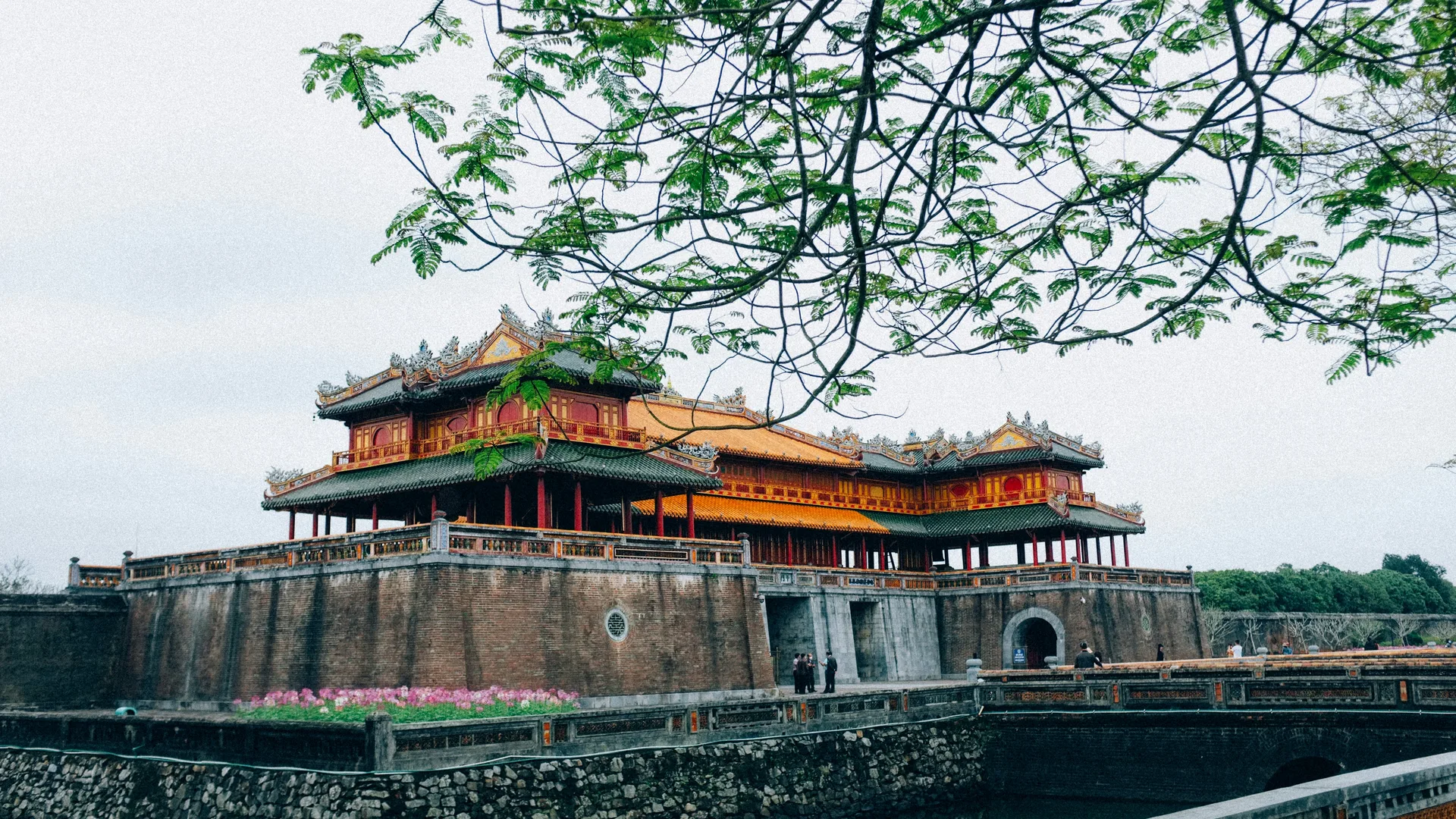
The Ngọ Môn Gate (Cổng Ngọ Môn, the Meridian Gate) is the south entrance to the Imperial City and the most photographed structure in the complex. Built in 1833 under Emperor Minh Mạng, it has five arched entrances at ground level — the central one reserved historically for the emperor alone, the flanking arches for civil and military mandarins, the outer side-passages for elephants and horses. Above the gate sits the Ngũ Phụng (Five-Phoenix) Pavilion, a pavilion-topped reviewing platform from which the emperor presided over ceremonies in the courtyard below. The gate's curving yellow-tiled roof and the layered, pavilioned silhouette are the iconic image of Hue.
Two ceremonies make this gate historically significant. The first is the proclamation of new reign titles, when each Nguyễn emperor formally declared his rule from the Ngũ Phụng platform. The second — at the other end of the dynasty — is the abdication of Bảo Đại, the thirteenth and last Nguyễn emperor, on 30 August 1945. Bảo Đại handed the imperial sword and seal to representatives of Hồ Chí Minh's Việt Minh from this platform, ending more than 1,000 years of monarchic rule in Vietnam. A small interpretive plaque marks the spot. After the gate, cross the Golden Water Bridge (Cầu Trung Đạo) over the moat-like Thái Dịch lake and continue north on the central axis toward Thái Hòa Palace.
Thái Hòa Palace: The Throne Hall
Thái Hòa Palace (Điện Thái Hòa, the Palace of Supreme Harmony) is the dynasty's principal throne hall and the ceremonial centre of the Imperial City. The hall sits on a raised stone platform, oriented exactly on the north-south axis, with the throne placed under a carved wooden canopy at the rear. Eighty red-lacquered ironwood columns support the roof, each decorated with gilded dragon motifs — the most concentrated display of dragon iconography in any surviving Vietnamese palace. The hall hosted the most important court rituals: coronations, the lunar new year audience, and the formal reception of foreign ambassadors. During these ceremonies civil and military mandarins assembled in the courtyard outside, ranked by status on stone markers still visible underfoot.
The hall has undergone several rounds of restoration. The most recent — a comprehensive structural and decorative programme by the Hue Monuments Conservation Centre — extended through the early 2020s and addressed termite damage, roof-tile replacement and column re-lacquering. Visitor access during conservation rotates: typically the interior is open with a fenced path leading visitors past the throne. Photography is allowed but flash is restricted to protect the lacquered surfaces. Information panels in Vietnamese and English explain the ceremonial layout. After the hall, the route continues north through the Đại Cung Môn (Great Palace Gate) into what was the inner sanctum — the Forbidden Purple City.
The Forbidden Purple City
The Forbidden Purple City (Tử Cấm Thành) was the innermost of the three concentric enclosures and the private domain of the emperor, the empress, royal concubines and eunuchs. The colour purple in the name is symbolic — purple was the emperor's colour, associated in Sino-Vietnamese cosmology with the North Star around which the heavens revolved. Entry by any other person was punishable by death. The original complex contained dozens of timber pavilions arranged around courtyards: residential halls for the imperial family, a Reading Pavilion, kitchens, libraries and the residence of the empress dowager. What you walk through today is mostly absence.
The 1968 Battle of Huế devastated this inner enclosure. North Vietnamese forces held the citadel for 26 days under combined US and South Vietnamese (ARVN) artillery and air bombardment; the timber pavilions burned, and what remained was subsequently cleared. Of approximately 160 original buildings in the wider Imperial City, only about 30 survived intact. Reconstruction since 1993 has restored individual buildings — the Tả Vu and Hữu Vu (left and right office halls) flanking what was the main residential axis, and partial restorations of several smaller pavilions — but the bulk of the Forbidden Purple City remains as foundations and exposed courtyards. Walking it is deliberately quiet; the scale of the loss is the point.
The Nine Dynastic Urns and the Temple of Generations
On the western side of the central axis, behind the Hiển Lâm Pavilion, stand the Cửu Đỉnh — the Nine Dynastic Urns. These nine massive bronze urns were cast between 1835 and 1837 under Emperor Minh Mạng and placed here as a permanent embodiment of the dynasty. Each urn is dedicated to one Nguyễn emperor and bears 17 engraved motifs representing the landscapes, rivers, flora, fauna and astronomical phenomena of Vietnam — collectively a bronze atlas of the kingdom. The urns weigh between 1,900 and 2,600 kilograms each. They survived the 1968 destruction and stand today essentially as they were cast. UNESCO added them to the Memory of the World register in 2024 in recognition of their documentary value.
Directly behind the urns is the Thế Miếu (Temple of Generations, also known as Thế Tổ Miếu), the dynasty's principal ancestral temple. Inside, altars are dedicated to each of the Nguyễn emperors, with portraits, ceremonial objects and biographical inscriptions. The temple is the religious heart of the complex and the place where contemporary Nguyễn-family commemorations are still held on the anniversaries of each emperor's death. Visitors are asked to remove hats and lower voices inside. The Hiển Lâm Pavilion in front of the temple — a tall, slender three-storey structure — is one of the few pre-1968 buildings to have survived without major damage.
The Royal Theatre, the Reading Pavilion and Exit Loop
The Royal Theatre (Duyệt Thị Đường) sits on the eastern side of the Imperial City and is one of the oldest surviving theatres in Vietnam. Built in 1826 under Emperor Minh Mạng, it staged tuồng (Vietnamese classical opera) and nhã nhạc cung đình (royal court music) for the emperor and his guests. The building was extensively restored in the 1990s and now hosts daily court music performances on a published schedule — typically two short shows per day in the main tourist season. The nhã nhạc tradition was inscribed by UNESCO on the Representative List of the Intangible Cultural Heritage of Humanity in 2003. Even a 20-minute performance is worth catching: the instruments and costumes are unchanged from the dynasty's surviving documentation.
The eastern and western perimeter routes loop back toward the Ngọ Môn exit through a series of smaller courtyards and side gates — the Hiển Nhơn Gate to the east is a quieter way out toward the Đông Ba Market. Along the way, the Cần Chánh Palace foundations (the everyday administrative hall, destroyed in 1947 and not yet rebuilt), the Tô Miếu side temple, and the Kiến Trung Palace at the far north (a French-Vietnamese hybrid completed under Emperor Khải Định and substantially restored in 2019) are worth a detour. Allow 2.5 to 3 hours for the full circuit at a steady pace. For a slower visit with a guided narrative across the surviving monuments, half a day is comfortable.
Frequently asked
Which monument inside the Citadel should I not miss?
The Ngọ Môn Gate, Thái Hòa Palace, the Nine Dynastic Urns and the Thế Miếu Temple of Generations are the four canonical sights. Add the Royal Theatre for nhã nhạc court music if performance times match your visit.
How much of what I see is reconstruction versus original?
A meaningful but not overwhelming proportion is original. The Ngọ Môn Gate, Thái Hòa Palace structure, the Nine Urns, the Hiển Lâm Pavilion and the Thế Miếu temple are largely original or carefully restored. Most of the Forbidden Purple City is foundations only after 1968.
Is the Forbidden Purple City worth visiting if most of it is gone?
Yes. The scale of the foundations, the surviving Tả Vu and Hữu Vu halls, and the contemplative emptiness convey the loss in a way that intact reconstruction would not. Active restoration is visible and explained on interpretive panels.
How long does the Citadel circuit take?
About 2.5 to 3 hours at a steady pace, including stops at the four headline monuments and a short court music performance at the Royal Theatre. Half a day is comfortable for a slower visit.
Can I get an English-language tour inside the Citadel?
Yes — licensed English-speaking guides can be hired at the Ngọ Môn ticket office, and most concierge combo packages include a guide for the citadel and tomb day. Audio guide availability varies; confirm on arrival.
Where exactly did Bảo Đại abdicate?
From the Ngũ Phụng (Five-Phoenix) Pavilion atop the Ngọ Môn Gate, on 30 August 1945. A small interpretive plaque marks the location. The handover ended more than 1,000 years of monarchic rule in Vietnam.
Are the Nine Dynastic Urns the originals?
Yes. They were cast between 1835 and 1837 under Emperor Minh Mạng and survived the 1968 destruction intact. UNESCO added them to the Memory of the World register in 2024.
Is there a recommended route through the Citadel?
Enter at Ngọ Môn, cross the Golden Water Bridge, take the central axis north through Thái Hòa Palace, continue into the Forbidden Purple City, loop west to the Nine Urns and Thế Miếu, then east to the Royal Theatre, and exit via Hiển Nhơn Gate.
Can I attend a court music performance inside the Citadel?
Yes — the Royal Theatre stages daily nhã nhạc performances on a published schedule, typically two short shows per day in the main tourist season. The tradition is UNESCO Intangible Heritage, inscribed 2003.
Is photography allowed inside the throne hall?
Personal photography is allowed in Thái Hòa Palace; flash is restricted to protect the lacquered surfaces. Tripods and professional equipment may require prior permission from the Hue Monuments Conservation Centre.